
That Sound? Japan Yawning at iPhone
By Bruce Wallace
Times Staff Writer
6:41 PM PST, January 10, 2007
TOKYO -- Tomoaki Kurita presides over racks of cell phones lined up outside his shop on a busy sidewalk in Harajuku, Tokyo's catwalk of youth street culture where people attracted by the riot of phone options can stop to flip open and fondle latest models of what the Japanese call a "keitai."
From behind his busy counter, Kurita giggles when asked about the excitement in America over the arrival of Apple's iPhone cell phone that also could be used to download music and surf the Internet.
"Sounds like business as usual," he says.
As stock markets swooned and techies buzzed over Apple Inc. CEO Steve Jobs' long-awaited entry into the mobile-phone market, Japanese consumers could be excused for wondering: Why the fuss?
Many Japanese had a hard time buying Jobs' hype about "reinventing" the phone. The revolution is well under way in Japan, where cell phones are used for everything from navigating your way home by GPS to buying movie tickets and updating your blog from wherever you are.
Oh yeah. Japanese cell phones also download music, surf the net and make phone calls.
They've been a natural extension of daily life the past few years, spurred by the Japanese decision to be the first country to upgrade to third-generation mobile-phone networks, or 3G, which increased broadband capabilities and allowed for greater, faster transmission of voice and data. Apple's iPhone, by comparison, will operate on a 2G network.
It was 3G that sparked the boom in music downloads that makes it common for phones to be used as portable digital music players here.
And it is 3G that has led the Japanese into a world where they can watch live TV on their phones, use the phone as a charge card to ride trains or buy milk at the corner store or take a taxi, and conduct conference calls between as many as five people. Ticket Pia, Japan's major entertainment ticketing agency, has been selling e-mail tickets to cell phones since 2003.
Most observers contend the U.S. has begun to close the gap on mobile-phone use in Japan, South Korea and Europe. Music downloads by cell phone are rising in the U.S. -- and the long-term threat to iPod's lead in downloads was a major force behind Apple's entry into mobile phones. Other functions are following.
"We plan to introduce one-way video conferencing in the U.S. this year," says Melissa Elkins of LG Electronics MobileCOMM, referring to a function that would allow one person to be visible to the other during a phone call. Two-way telephony has been available in South Korea for about 18 months, Elkins says.
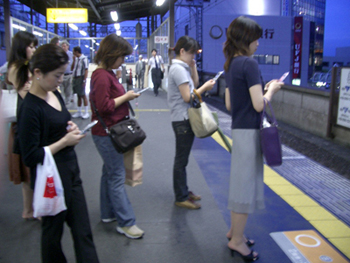
But the biggest difference between the U.S. and countries like Japan is the culture the keitai has created. To wait for a light on a Tokyo street corner or ride a train these days is to see crowds of people with their heads down, thumbs pumping as they send photos, text message or play online games on their phone. Increasingly, they are reading books and manga on their phones, too.
The keitai has become an extension of personality. There is software to create a personalized home page on the cell phone. Young men and women customize their phones, hang posses of tiny dolls off them, cover them with stickers and paints. "I like it because it's cute," says Mami Nawa, 23, as she shows off the dial pad she has painted in purple and pink tones. "And with my long nails, the paint gives me a better feel for the phone. It curves more."
Nawa spent about $170 on her sharp phone and another $25 to decorate it, although she says some friends spend much more -- on the decoration, not the phone. But neither she nor friend Makiko Yamada, who are sampling the phones in Harajuku, would not pay anything close to $500 for a cell phone, they say.
Like other Japanese consumers, Nawa and Yamada pick and choose the functions they want. They don't use their phones as charge cards -- known here as the "wallet function." But they check train schedules and have made hotel reservations with their phones. They keep music on their phones and subscribe to daily e-mails that deliver news headlines and fortune telling. They shop from their phones from online sites and bid for goods in online auctions.
It's a dynamic market. After buying Vodofone's Japanese operations, Internet company Softbank has made a splash with a campaign claiming to offer significant savings for customers who switched to their service. That process has been made easier by industry changes allowing customers to take their existing phone number with them when they switch carriers.

