Monday, July 03, 2006


With the Right Spin, Any Film Can Be No. 1

By Josh Friedman
Times Staff Writer

July 3, 2006

It wasn't enough that the comedy "Scary Movie 4" premiered to a healthy $41 million at the box office in April, setting an Easter weekend record.

Distributor Weinstein Co. further boasted that it was the biggest movie opening in the company's history — all six months of it.

After 20th Century Fox opened its horror remake "The Omen" on the Satanic-sounding "6/6/06" date, the studio dashed off a news release proclaiming the $12.6-million take was "The Biggest Tuesday Opening in Motion Picture History."

Then again, studios almost never launch films on Tuesday because it's one of the lightest moviegoing days of the week.

When it comes to claiming bragging rights in Hollywood, no milestone is too obscure to exploit. Eager to find any marketing hook, studios each weekend put the box-office numbers through a Veg-O-Matic-style analysis, slicing and dicing figures to suit their needs. As a result, records are being set at, well, a record clip.

"It's all gone crazy," said Bob Weinstein, co-chairman of Weinstein Co. "Everybody is creating records, including us, to tout the fact that we're No. 1. The significance is not much, but we cop to being part of it."

Hollywood has long featured carnival barker-like promotion seeking to lure people into theaters. But the weekly drumbeat highlighting the thinnest of achievements has gotten so out of hand, said veteran movie distributor Tom Sherak, that he expects someone to soon claim: "The best opening without somebody in it who was born on a Tuesday morning."

Movie grosses are often subjected to mind-numbing analysis. Last week's premiere of "Superman Returns" was touted as the eighth-biggest Wednesday opening, but it slips to 11th if you exclude Tuesday night advance showings.

It's no longer enough to be among the weekend's top-grossing movies. With the TV, print, radio and online media obsessed with the weekly box-office derby, studios each Sunday scramble to come up with any statistics that set their films apart from the competitive pack, even if those boasts come with asterisks.

Universal Pictures noted that the $39.2 million grossed by its recent Jennifer Aniston-Vince Vaughn film "The Break-Up" was the highest three-day opening ever for a romantic comedy released in June.

The animated "Cars" won its opening weekend in early June with a strong $60.1 million but still fell shy of the $70-million estimates from some analysts. Nonetheless, Walt Disney Co. pointed to a batch of records, including the highest-grossing debuts of Paul Newman, Owen Wilson and Bonnie Hunt, who were voice actors in the movie.

"Those are a little dubious," said Brandon Gray, an analyst at the Box Office Mojo website. "First of all, they're not really in the movie."

Winning the weekend in any niche category can provide a marketing opportunity: DreamWorks Animation and Paramount Pictures advertised "Over the Hedge" as "America's No. 1 comedy" this summer even though it grossed half the revenue of drama "The Da Vinci Code."

"Highly competitive industry that this is, you look for any marks of achievement," said Robert Levin, former film marketing executive at Walt Disney, Sony Pictures Entertainment and MGM studios.

Today's claims are an outgrowth of the box-office obsession that took off in the early 1980s, when studios cultivated media coverage by calling reporters Sundays with estimated weekend results. With the release of blockbusters such as the original "Batman" in 1989, studios more aggressively promoted their weekend winners and started sifting through the numbers to find records they could flaunt.

At the time, the unofficial repository of box-office statistics was just a phone call away in the form of the late Art Murphy, the gruff, chain-smoking Variety reporter who pioneered coverage in the 1960s. If a studio believed that its film had broken a record of some sort, an executive often would quietly contact Murphy to confirm it before crowing publicly.

"If you were on his list of people he would talk to, he would tell you the answer," said Robert Friedman, a former executive at Warner Bros. and Paramount Pictures.

Today's records, which studios verify with such box-office tracking firms as Nielsen EDI and Exhibitor Relations Co., can border on arcane.

Michael Moore's "Fahrenheit 9/11" set a record for a documentary when it premiered in 2004 at $21.8 million.

But that's not all. It also broke the mark for a movie opening at fewer than 1,000 theaters, dethroning "Rocky III." And it had the highest-grossing opening among films that had won the Cannes Film Festival's Palme d'Or award, beating "Pulp Fiction."

For good measure, it notched the smallest year-to-date percentage drop in revenue from Saturday to Sunday — excluding Memorial Day weekend and children's movies.

"These records are mind-blowing," a giddy Moore wrote on his website.

Although records enable a studio to put an exclamation point on a robust opening, stressing an obscure mark also can be a tip-off that the movie disappointed.

"The more adjectives you have to put before a number, the less credibility it has," said Jeff Blake, head of worldwide marketing and distribution at Sony Pictures.

Executives acknowledge that records can be a stretch, but say the accomplishments would hold no promotional value if not for the news outlets clamoring for box-office details.

Bruce Snyder, 20th Century Fox's domestic distribution president, said he was stunned by how many horror fans flocked to "The Omen" on its Tuesday premiere. But, he said, he didn't realize it had set a record until a reporter asked him about it the next morning, hours before the studio put out its news release.

"I don't really think it has any meaning," Snyder said of the record, "but it is a way to capitalize on the initial success. People who see that it produced outstanding results might decide to go to the film."

Studios also point to personal bests, especially for major stars, which has the added effect of stroking the talent.

"If you have someone as beloved as Paul Newman in your movie, then you're going to give him the credit he is due," said Chuck Viane, Disney's president of distribution.

In the parody spirit of "Scary Movie 4," Weinstein called the movie "the No. 1 grossing Chris Elliott comedy of all time in the history of the universe," joking about the offbeat comedian with whom he is close friends. "And I feel safe in saying it'll be a long time before that one is broken."

The most obscure records have a ready outlet in trade publications, which chronicle box-office highs and lows in minute detail. In March, the Hollywood Reporter noted that "Inside Man" booked $820,000 at 23 screens in Mexico — an all-time record opening there for a Denzel Washington-Spike Lee film.

One reason records fall so readily today is that, as with many sports achievements, it's easy to outdistance marks set in an earlier era. Ticket prices nationwide average $6.41, versus $4.22 in 1990, the National Assn. of Theater Owners said. Studios in recent years also have increasingly put their muscle behind films' premiere weekends, opening as widely as possible and launching ad blitzes to generate as big a number as possible.

"Superman Returns," which opened Wednesday at 3,915 theaters, leaped in a single bound past previous records for the Man of Steel. That's because the current standard-bearer, 1980's "Superman II," chalked up $14.1 million in its first weekend at one-third as many venues. That number was impressive then, but blockbusters today can gross that amount in a few hours.

Likewise, the exponential growth in foreign box-office receipts and in DVD sales has given Hollywood more record fodder. Films now often get wide releases dotting the globe, rather than the gradual international rollouts of years past.

"Mission: Impossible III" brought in $47.7 million in the U.S. and Canada when it opened in early May, falling shy of lofty Wall Street estimates. But Paramount pointed out that the Tom Cruise thriller grossed an industry record of $1.1 million in the Middle East, a studio record of $1.7 million in Thailand and a Cruise record of $938,000 in Indonesia.

Box-office numbers have never been as finely parsed as they are now. Nonetheless, some of Hollywood's early promoters saw the value of claiming milestones, no matter how fleeting they would eventually prove.

In December 1957, Times Hollywood columnist Philip K. Scheuer reported the "astonishing" $31-million first-year gross for Cecil B. DeMille's "The Ten Commandments," getting his information straight from the legendary showman.

"There has never been anything like it," Scheuer declared. "At least to date."

Sunday, July 02, 2006

washingtonpost.com
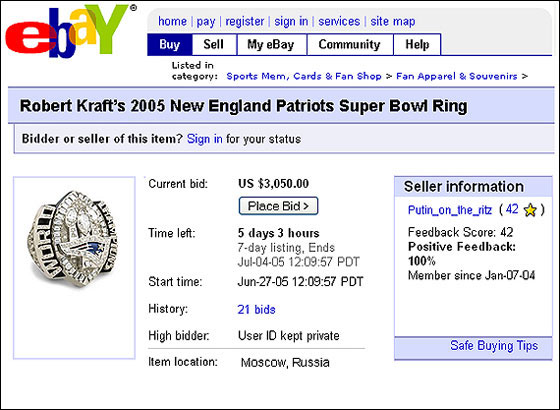
Self-Defense For EBay Buyers
Avoiding Unpleasant Surprises On World's Biggest Auction Site

By Kathleen Day
Washington Post Staff Writer
Sunday, July 2, 2006; F01

Stephanie Marhefka bought several dresses and a laptop computer over the years on eBay without problem. But the psychologist says her last purchase was a disaster: She paid $700 for what an eBay seller said was a solid wood desk, plus an additional $40 for the Brooklyn merchant to deliver it to her mid-Manhattan apartment.

The desk she received in 2004 turned out to be damaged and made with veneer, not solid wood. The seller's promise to replace it never panned out. EBay's suggestion for remedying the situation went nowhere. Two years later, the seller's phone is disconnected and Marhefka is stuck with an unwanted desk.

Michael R. Dimino, a law professor at Widener University in Harrisburg, Pa., has made 30 or so purchases on eBay without incident. But his luck ran out last December, when the PlayStation 2 video game system he paid $100 for never arrived. He soon discovered that other buyers had complained about the seller.

Goods that are damaged, counterfeit, don't match what was advertised or are never delivered remain a persistent problem for eBay and its customers -- even though the numbers represent a relatively small fraction of transactions on the Web site. How big a problem is unclear. EBay Inc. does not disclose specific totals.

The auctioneer has been an Internet wunderkind, evolving since its founding in 1995 from a folksy, funky cyberspace flea market into a Web phenomenon that's the most visited e-shopping site. Last year, 546.4 million items were listed for sale on the site, up from 79.4 million five years earlier.

While eBay officials say the vast majority of transactions take place without a hitch, company spokesmen acknowledge that the growth in online buying has been accompanied by a growth in online disputes, from simple disagreements over a sweater's color to more serious allegations. And, says eBay spokeswoman Catherine England, fraud also occurs against sellers, when buyers don't pay up as agreed.

Cracking down on such problems has been a hot topic at the annual "eBay Live!" gatherings of buyers, sellers and company executives. This year's, in Las Vegas in June, was no exception: EBay president and chief executive Meg Whitman in her keynote speech ticked off a number of improvements in eBay's online dispute-resolution process.

"We're confident that is going to result in a significant reduction in buyer claims against sellers, which will be great for everyone in the eBay family," she said.

EBay says only 1/100 of 1 percent of the items on sale last year ended up as confirmed cases of fraud. That fraction multiplied by the number of items offered for sale last year yields 54,640 cases, though some company critics suspect the actual number is much higher. The company defines fraud as either a buyer not paying for goods received or a seller not delivering a product or sending one that is counterfeit, damaged or otherwise not as promised.

Ina Steiner, editor of AuctionBytes, an online newsletter that follows eBay and other electronic auction sites, said the estimate does not include many unresolved disputes that exceed the company's time limits for consideration or were not counted for other procedural reasons. It also does not include cases in which customers persuade their credit card company to cancel the charge. And Steiner points out that by comparing confirmed cases of fraud with the number of goods listed rather than the number of actual sales, eBay makes the percentage seem smaller.

Whatever the numbers, consumers can reduce their chances for problems by following a few simple tips, eBay executives and eBay watchers say.

First, use PayPal, an eBay subsidiary that makes online bill paying more secure by acting as an intermediary between buyers and sellers. Consumers give PayPal their credit card, debit card or bank-account information. PayPal then pays for a item on behalf of the buyer without divulging personal financial information to a merchant.

Second, pay PayPal with a major credit card or, depending on your bank's policy, a debit card so you can have the issuing bank investigate claims of wrongdoing. For example, if you report a problem to Visa, the company will do what is called a "chargeback," said Visa USA executive Niki Manby. That means it will remove the charge in question from your credit card -- and, in Visa's case, from your debit card -- while it investigates your claim with PayPal.

If you prefer not to rely on PayPal, insist at least on using a credit card. Again, that will allow you to request a chargeback. Be suspicious of any vendor who won't use PayPal or accept a credit card and "wants a check or money order," England said.

Should you suspect that you have been scammed, there are several steps you can take.

If you used PayPal, fill out the dispute form on the eBay site, which can be found by clicking on the "Security and Resolution Center" button at the bottom of the eBay home page. Follow the instructions, including those asking the buyer to contact the seller to try to work things out. You have to do that, in fact, before you can elevate your "dispute" into a claim, where you are essentially applying for monetary reimbursement from PayPal.

PayPal offers two reimbursement programs. One will reimburse a buyer up to $175 for general purchases, and another refunds buyers up to $1,000 if they bought from a seller who met certain eBay criteria for trustworthiness. In going through the process, there are many deadlines to meet and exceptions to watch. "Buyers have to know what the rules are," said PayPal spokeswoman Amanda Pires.

Since the process can take a while, it pays to think a bit about how strong your claim is.

If you feel you are on solid ground -- say, you want your money back because the purchase never arrived -- Steiner and others recommend that you wait only a couple of days or so before contacting your credit card company to request a chargeback. This will ensure that you don't miss a chance to get the charge erased.

The risk, of course, is that once the credit card company is finished with its investigation, it may not find in your favor and could reinstate the charge. Further, PayPal warns customers that it will no longer process claims once a chargeback is requested. At that point, it is up to the credit card company to sort things out.

Marhefka, the New York woman who bought a desk, didn't contact her debit card company. By the time she went through the eBay resolution process, the deadlines for filing with PayPal had expired. She did go to small-claims court and win, but she can't find the seller. She effectively is out the money.

Dimino, by contrast, contacted Discover Card within a few days of filing his PayPal forms online. Discover took the $100 charge off his account, and he hasn't heard anything about it since, except from PayPal to say his claim with it had been canceled.

Dimino says he has no bad feelings about eBay and blames himself for not checking out the seller more closely. But he also says his generally positive attitude about the whole episode is largely colored by having gotten his money back, and fast.

EBay officials say another strong consumer protection is the ability to leave negative comments about a seller, which other potential buyers can see at the time of purchase. But critics of the system say it's weakened over the years. Aggressive sellers, for instance, can retaliate against consumers who file disputes by leaving negative comments about buyers, which might make other sellers shun them.

At the eBay gathering in Las Vegas, there was much discussion on how to change the system. Some buyers and sellers elect to go to a third-party mediator -- eBay suggests SquareTrade Inc. -- to work out an agreement for both sides to retract negative comments about each other, company officials say. EBay also is considering making it harder for those who lose a dispute to leave unfavorable ratings.

Beyond the comment system, the auctioneer has enlisted the help of brand-name manufacturers to police the site for fake Burberry scarves, Prada or Juicy purses, Tiffany jewelry, or other counterfeit items. "EBay cannot pretend to be an expert on everything," England says.

The company has set up a system allowing companies to contact it about removing a suspicious item. But the system has flaws. Some eBay sellers have successfully sued stores for filing erroneous complaints. And others think eBay could do more. The high-end jeweler Tiffany and Co. has sued the company, arguing that eBay is responsible for the sale of illegal goods through its venue.

Last month, eBay announced it was going to have tougher screening for overseas sellers, where it believes most counterfeit items come from.

And the final tip on protecting yourself on eBay? Just like in the stock market or at a gambling casino, don't buy something you can't afford to lose.


CNET News.com

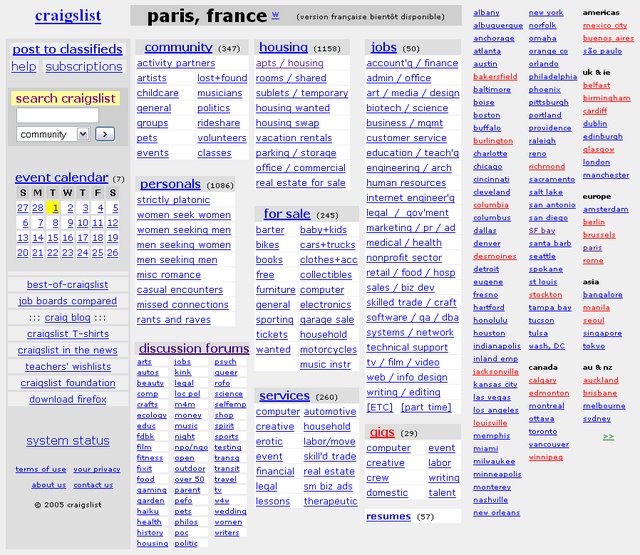
Craigslist's Craig Newmark--no more Mr. Nice Guy?

By Greg Sandoval
Wed Jun 28 10:25:10 PDT 2006

Craigslist.org founder Craig Newmark has a message for the British media mogul--a knight no less--who recently called him a "socialistic anarchist."

During an interview last week, a smiling Newmark offered up a little history lesson in response: "In the 1780s (following America's War of Independence), the British commonly referred to the American experiment as anarchism," the 53-year-old Newmark said. "And look...it's kind of working out."

Craig Newmark Craig Newmark

Considered by many to be one of the most benign of Silicon Valley's top innovators, Newmark has shown a feistier side recently. When he's not verbally jousting with knights, the mastermind behind the Web's top classifieds publication can be found beating a drum for Net neutrality or defending his namesake network of sites against claims that it allows people to post discriminatory housing ads.

He's suggested that Cox Communications wrongfully blocked access to his site, and he's fended off criticism from New York real estate brokers who got peeved when Craigslist began charging them $10 to post apartment listings. And then there's the longtime grudge against Craigslist held by many newspapers executives, who claim the network is almost single-handedly killing their industry.

So is this a case of no more Mr. Nice Guy?

"We do what feels right to us," Newmark told a crowd of executives last week at the Supernova 2006 media conference. "That's our idea of a moral compass."

Up to now, Newmark's compass is apparently pointing him in the right direction. Last week, Craigslist expanded into 100 new cities and now operates in 300. Each month, customers view 4 billion pages on the family of sites and employers post more than 500,000 new job listings, said Jim Buckmaster, CEO of the privately held company.

Craigslist allows anyone to post ads for almost anything they want to sell, without charging them a cent. Buyers don't pay either. People find jobs, rooms to rent, pets, furniture and clothes, as well as lovers, on Craigslist. The effect of the network on our society is hard to gauge, but it's difficult to find anyone in the tech sector or in the nation's biggest cities that hasn't unloaded an old couch or found a roommate on the site.

"I love Craig," said Forrester Research media analyst Charlene Li. Typically conservative when discussing companies she covers, Li gushes when talking about Newmark. Before refurbishing her home recently, Li sold most of its contents on Craigslist, right down to the doorknobs. "Everybody has their own Craigslist story" she said.

Few companies have fostered as much customer loyalty. That's largely due to Newmark's almost fanatical attention to customers. He started the list in 1995 as a way to inform friends about special events in San Francisco. From there, the list grew into a company, and Newmark found that he enjoyed working with the public more than overseeing day-to-day operations. Thus, he turned those duties over to someone else and now carries the unusual dual titles of chairman and customer service representative.

He could be at the helm of the company or sit around as its "glamorous figurehead" (as the self-proclaimed nerd has said jokingly), but instead, he spends his days reading e-mails and answering customer complaints--a practice he says even the most high-powered CEO should partake of from time to time.

Another element of the company's popularity among customers is its consistent stance on social responsibility. Sure, plenty of businesses say they care about people and customers, but few forgo profits in order to "give people a break," the Craigslist mantra. The company could be slicing off a tasty share of the billion-dollar classifieds pie for itself. Instead, Craigslist is satisfied with the $25 million it took in last year, according to a story last week in The Wall Street Journal.

But how does Newmark's philosophy on social responsibility jibe with his company's undermining of the revenue that once powered newspapers, historically society's watchdog? Classifieds once made up more than half the profit at many newspapers. That number has steadily declined in recent years.

Martin Sorrell, chief executive of British media and advertising company WPP, warned traditional media companies to beware of destroyers of traditional business models, according to a report published last week in The Financial Times' online edition. Sorrell singled out Craigslist, according to the newspaper, when he asked the Times: "How do you deal with socialistic anarchists?"

Craigslist as a killer of newspapers is "more mythology than truth," Newmark said. The site is having an effect, but newspapers have bigger problems, with falling circulation stemming in part from the public's growing distrust of mainstream media, he said. Newspapers themselves, he said, are dropping the ball when it comes to responsibility: "Newspapers fail to speak truth to power," he said. The media outlets Newmark praises are decidedly new school: television's "The Daily Show" and "The Colbert Report" and the satirical Web site The Onion.

Consumer rights fight
Still, nothing fires up Newmark more than a fight over consumer rights.

For example, he resisted charging for apartment listings in New York, Li said, until becoming convinced that it was the best way to discourage unscrupulous real estate brokers there from posting "bait-and-switch" listings or repeatedly adding the same listing to the site so that it would remain among the most current ads. When customers perform a search on Craigslist, the company's policy is to display the most recently posted listings first.

Another hot spot has involved Net neutrality. Telecommunications and cable companies have hinted that they may charge companies that eat up more bandwidth than others. Net neutrality proponents, including Newmark, want every Web site to be treated equally, and don't want big businesses acting as gatekeepers. In the end, it's consumers who may end up paying the price. Craigslist has become a poster child for neutrality proponents after Cox Communications recently blocked access to the site. Cox, owner of cable and newspaper operations, blames an unintentional systems glitch for the problem. The problem is still unfixed after more than 100 days and that's made conspiracy theorists of some in the neutrality camp.

And then there's the accusation that Craigslist violated the Fair Housing Act by letting people post discriminatory rental ads. The company is fighting these accusations and last week got a hand from Google, Amazon.com, AOL and Yahoo. According to the National Law Journal, the companies filed a brief in the U.S. District Court in Chicago, saying that ruling against Craigslist could harm the future of many online service.

Still, such charges must hurt someone like Newmark deeply, Li said.

Newmark doesn't belong to any minority group and readily acknowledges that his family was not among the poorest in his New Jersey hometown. Nonetheless, he says he shares an affinity with marginalized groups after growing up a nerd, complete with pocket protector and glasses held together by electrical tape.

"The nerd people as a nation are my people," Newmark said. "That means I can identify, to one extent or another, with people who are left out or disenfranchised. I've never been disenfranchised all that much. I'm speaking a little bit out of turn, I know. But what that means is I know I need to pay attention to people who are seriously left out."

And this goes hand in hand with Newmark's basic philosophy on life and business.

"If you want to be successful try to do the right thing," he said. "In the short term you can succeed by screwing people, but it doesn't work too well long term."

The New York Times


July 2, 2006
The Public Editor

Secrecy, Security, the President and the Press

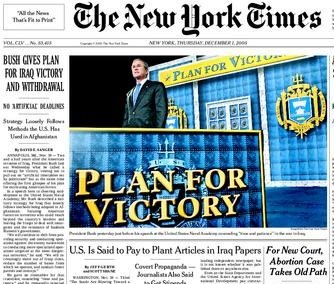
THE Bush administration's unusually harsh attacks on The New York Times for exposing a secret banking-data surveillance program have turned a glaring spotlight on the paper's decision to publish the article.

President Bush, Vice President Cheney and Republican legislators have singled out The Times in recent days for disclosing the counterterrorism program, even though The Los Angeles Times and The Wall Street Journal published articles the same day. Senator Jim Bunning of Kentucky called on the attorney general to investigate The New York Times for treason.

The flood of reader e-mails reacting to the June 23 article has left hundreds of messages in various newsroom in-boxes at The Times. Roughly 1,000 e-mails have come to me, about 85 percent of them critical of the decision to publish the story and a large fraction venomous. It was time to take a close look at the handling of the article in search of answers.

My close look convinced me that Bill Keller, the executive editor, was correct in deciding that Times readers deserved to read about the banking-data surveillance program. And the growing indications that this and other financial monitoring operations were hardly a secret to the terrorist world minimizes the possibility that the article made America less safe.

The banking-data surveillance program, set up in 2001, is run out of the Central Intelligence Agency and overseen by the Treasury Department. It provided access to records of transactions routed through a Belgian consortium by banks and financial institutions around the world. More than 11 million transactions involving about $6 trillion are routed daily through the Society for Worldwide Interbank Financial Telecommunication, or Swift.

So what were the most solid reasons to publish the story?

There was a significant question as to how secret the program was after five years. "Hundreds, if not thousands, of people know about this," Mr. Keller said he was told by an official who talked to him on condition of anonymity. The 25 bankers from numerous nations on the Swift board of directors, and their predecessors going back to 2001, knew about the arrangement. So did some consortium executives and staff members — a group that probably expanded during this period. Starting in 2003, Swift representatives had to be stationed alongside any government intelligence official searching the data.

Further support for the conclusion that the Swift program hasn't remained totally hidden from terrorists, or anyone else, emerged last week. A former State Department official who has served on a United Nations counterterrorism group pointed to a 2002 United Nations report noting that the United States was monitoring international financial transactions. Swift and similar organizations were mentioned in the publicly available report, although there were no details. "The United States has begun to apply new monitoring techniques to spot and verify suspicious transactions," the report noted.

The Times's June 23 article "awoke the general public" to the Swift program and "in that sense, it was truly new news," Victor Comras, the former State Department official, wrote on The Counterterrorism Blog last week. "But," he added, "the information was fairly well known by terrorism financing experts back in 2002."

The administration has sometimes invited press attention to its effort to track terrorist financing. In September 2003, Treasury Secretary John W. Snow and a team of his aides took reporters from The Times and other papers on a six-day tour on a military aircraft "to show off the department's efforts," Mr. Keller and Dean Baquet, the editor of The Los Angeles Times, noted in a joint Op-Ed commentary that appeared yesterday. The aides "discussed many sensitive details of their monitoring efforts, hoping they would appear in print and demonstrate the administration's relentlessness against the terrorist threat," according to the two editors.

Another reason Times editors were right to proceed with the 3,550-word Swift story was the skimpy Congressional oversight of the program. Secrecy is vital for intelligence and national security programs, but so is oversight by the courts or elected legislators. The Swift program, however, doesn't seem to have any specific Congressional approval or formal authorization. The Treasury Department has not provided a list of who in Congress was informed, or when, The Times has reported.

Eric Lichtblau, one of the two reporters who wrote the Swift story, told me the administration briefed a limited number of Congressional leaders — apparently from both parties, but not the full intelligence or banking committees — toward the beginning of the program. It wasn't until the Treasury Department learned that The Times was working on the story, Mr. Lichtblau said, that the administration apparently briefed all members of the intelligence committees. Whether there are official standards established for the Swift program or not, the weak Congressional oversight over the past five years deserved public scrutiny.

Temporary emergency measures cloaked in government secrecy can too easily become permanent shortcuts. That's why oversight is important. It is also a reason to publish the article. The reservations expressed by some of the 20 current and former government officials and industry executives who were disturbed enough to talk to The Times were based on this concern: "What they viewed as an urgent, temporary measure had become permanent nearly five years later without specific Congressional approval or formal authorization," in the words of the article.

The most fundamental reason for publishing the article, of course, was the obligation of a free press to monitor government and other powerful institutions in our society. "Our default position — our job — is to publish information if we are convinced it is fair and accurate," Mr. Keller wrote in a letter to readers posted online last weekend, "and our biggest failures have generally been when we failed to dig deep enough or to report fully enough." He added:

"The question we start with as journalists is not 'why publish?' but 'why would we withhold information of significance?' We have sometimes done so, holding stories or editing out details that could serve those hostile to the U.S. But we need a compelling reason to do so."

What about the administration's reasons for demanding that The Times not publish?

Mr. Keller said the "central argument" senior officials gave against publishing the Swift article was that international bankers would stop cooperating. In his weekend letter, he cited two reasons that argument didn't stop him from publishing the story: First, the consortium provides data to comply with administrative subpoenas issued by the Treasury Department — a legal obligation. "Second, if, as the administration says, the program is legal, highly effective, and well protected against invasion of privacy, the bankers should have little trouble defending it." So far, Swift hasn't publicly indicated any intention to stop cooperating.

For me, the most substantial argument against running the story was the acknowledgment that the Swift program was letter-of-the-law legal, had helped catch some terrorists and had a clean record on privacy abuse. But full-bore oversight would have had to be part of that picture to make a convincing case that the program deserved to continue in secrecy, with its access to Swift's mother lode of financial data.

Often obscured in the past week's hot rhetoric over The Times's decision to publish the Swift article were the occasions when the paper's editors have chosen to hold or modify a story when warned by government officials that lives or national security might be endangered. "Few people are aware when we decide to hold an article," noted Mr. Keller and Mr. Baquet in their joint commentary. Apart from The Times's decision to hold the December story about the National Security Agency's warrantless eavesdropping for more than a year, it turns out the paper has decided not to publish stories that "might have jeopardized efforts to protect vulnerable stockpiles of nuclear material," according to the joint commentary. The Times has also held stories about "highly sensitive counterterrorism initiatives that are still in operation," the Op-Ed piece noted.

"There is no magic formula, no neat metric for either the public's interest or the dangers of publishing sensitive information," the two editors concluded. "We make our best judgment."

The best judgment of these two editors served their readers well in the case of the Swift story. In the face of intense administration pressure in a country that's unusually polarized politically, they correctly decided to make sure their readers were informed about the banking-data surveillance.


Saturday, July 01, 2006


FishBowlNY
Thursday, Jun 29

Isobella Jade: The FishbowlNY Interview

isobella_jade_fishbowlny.jpg

Yesterday, we reported the story of Isobella Jade, the 5'2" homeless model who has been pitching — in third person — Almost 5'4", her tragic-cum-triumphant memoir of her struggle as a height-challenged model, written entirely in heels at the SoHo Apple Store, around town.

We had but a pair of follow-up questions for her:

1. How were you saving your files?

2. Not to belittle your struggle in any way — seriously — but how are you "perhaps the most successful model in nyc under the height of 5'4"" and still living out of a suitcase?

Isobella's e-mailed response, written, presumably, from the Apple Store in SoHo:

FBNY: How were you saving your files?

Isobella Jade: On October 20th 2005 I first laid out my journals randomly into Microsoft Word at the Apple Store. The journals were my thoughts when I was just touching the surface of modeling, remembering my first photoshoot ever in my hometown of Syracuse, NY and during my sophmore year of college. It was about 60 pages of words. Then I saved it to my yahoo account. On November 4th 2005 I started to organize the order of how I wanted to tell my story if I ever got a chance to tell it one day. And as I wrote it I was living what I was writing. I stood at the Apple Store infront of a 17inch computer the one that I call " mine." I had been going to the store at the time for about 9 months. As I stood in heels for up to 2 hours at a time, my contacts and my mouth would go dry and without a blink of the eye I would pace back and forth from writing about my experiences to DOING the experience and the daily tasks of responding to emails, researching modeling jobs and places to send my comp cards. I was always in a rush running into and out of the Apple Store up to 3 times a day ... to go on meetings, photo shoots, and receive a potential paycheck and then right back to the store, I freelance so every minute in my day counts. From this past December 05 to January 2006 to February and till the middle of March, I have laughed out loud over it, typed frantically and received comments from employees to slow down and breath while I was staring at the screen viciously, vigorously. Sometimes asking a business man how to spell a word or two, right before I got to page 100, I grabbed a Wendy's Napkin out of my bag and saved a soda spill disaster all over the keyboard ,from a clumsy pre teen. I was at home at the Apple Store and I have even taken my heels off a couple times and stood barefoot as I wrote, and I wrote mostly in the evening and I was the last visitor to leave the store most nights. And while child howled and screamed for her mother, and 4 teenagers with dreadlocks crowded Itunes, laughing loudly with a "You gotta hear this," and swearing without shame, I let out my own smile and took a look to my right and saw 2 girls squeaking over their Myspace accounts, and then I took a sip of coffee, ... ... closed my eyes for 4 seconds, said a prayer and I finished my book. It was about 3 months ago, on the second computer ... on the right side store ... of the multi media table of the spectacular arrangement of Imacs. It was on a 17inch.

FBNY: Not to belittle your struggle in any way — seriously — but how are you "perhaps the most successful model in nyc under the height of 5'4"" and still living out of a suitcase?

Isobella Jade: Although Dylan please understand that my book is not a -show show- of my resume, it is my experiences working as an amatuer nude model for 2 years and then turning to a business women and learning how to sell myself without an agent to legit companies and jobs. It is about the struggles of being a model in a business of giraffes and how I manage to survive working with or without assistance. I was a track scholarship runner and advertising student less than 4 years ago and now I am my own agent. I work with a few agents freelancing, but mostly 90 percent of my resume is me me me. My book is called Almost 5'4 but I am big lier... I am really only barely 5'2. My compcard reads 5'4" because I am lean and I can pull it off. That is why I think I am the most successful model in NYC perhaps because who else is modeling full time who is barely 5'2 hahaha lying on her card saying she is 5'4 just to get into the modeling door? I used to model for internet amatuer sites when I was in college for my ego,for fun, I loved to be naked, and show off, but now I am living for the paycheck, for the ad campaign, for the brand, and out of my suitcase, sleeping on friends couches, eating dollar menu and basically a ragga muffin.